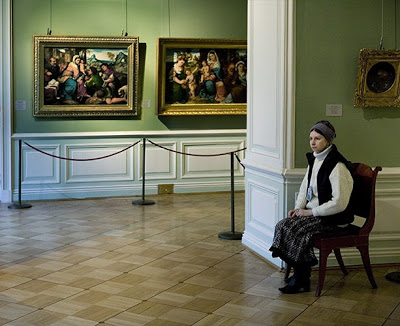
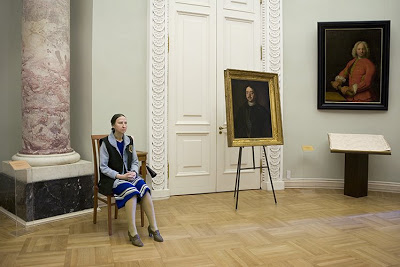
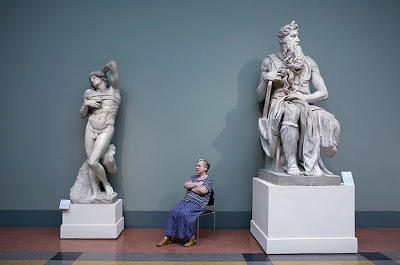
Guardians by Andy Freeberg

One of the things I love about this blog is getting to share work that I really like.
Andy Freeberg is a photographer who has a fresh new take on the art world, both thru his Sentry and Guardian portfolios. I was at the Hermitage in 2005 with a tour group and found the guards at the museum to be captivating.

Andy also recognized the beauty of these women and created an amazing body of work after several trips to Russia.
HermitageRussian State Museum
Pushkin Museum
Here is Andy's artist statement
"In the art museums of Russia, women sit in the galleries and guard the collections. When you look at the paintings and sculptures, the presence of the women becomes an inherent part of viewing the artwork itself. I found the guards as intriguing to observe as the pieces they watch over. In conversation they told me how much they like being among Russia’s great art. A woman in Moscow’s State Tretyakov Gallery Museum said she often returns there on her day off to sit in front of a painting that reminds her of her childhood home. Another guard travels three hours each way to work, since at home she would just sit on her porch and complain about her illnesses, “as old women do.” She would rather be at the museum enjoying the people watching, surrounded by the history of her country."
The Guardians will be exhibited at the Blue Sky Gallery in Portland, Oregon from March 5-29th. He is also the winner of Photolucida's Critical Mass Award for 2008.
Old Tretyakov Gallery

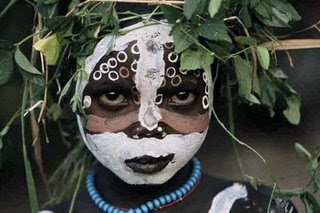
The Photography of Hans Silvester


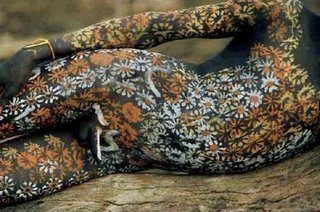
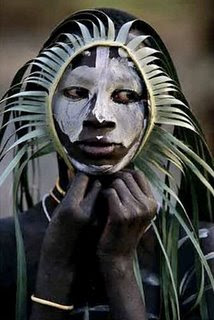
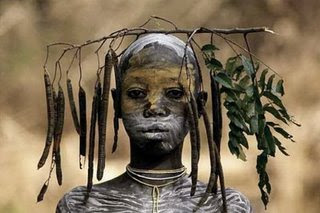
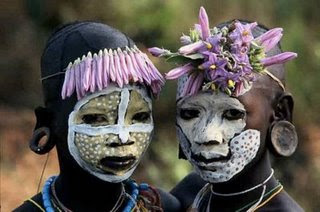
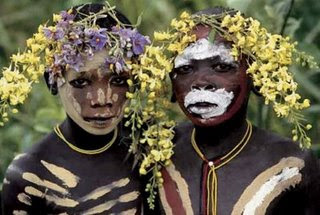
This work was brought to my attention last week. Stunning! Hans Silvester is a german photographer who worked in the Ethiopian Omo Valley. It really speaks to our relationship with nature and beauty...


Roberta Smith of the New York Times wrote on September 26th, 2008

"At once revelatory and disturbing, these color photographs taken over the last five years by Hans Silvester, a German photographer, document the extraordinary body painting of the Surma and Mursi peoples of the Omo Valley in southern Ethiopia. Semi-nomadic warriors, they live primarily by keeping large herds of cattle; their only Western accessory seems to be the Kalashnikov rifles they trade with Sudanese tribes.

They paint themselves or one another two or three times a day, using pigment made from earth or ground stone mixed with water. Executed quickly, the abstract, vibrantly patterned motifs reflect a sophisticated vocabulary of mark-making, finger-painting and hand-printing techniques; they extend across faces and sometimes center on a single feature, like a breast. They function as personal decoration, cultural expression and, when ash and cattle urine are added, insect repellent. Mr. Silvester says these people's interest in their painting supersedes any in sculpture, mask making, music or dance.

Mr. Silvester's pictures are almost exclusively closely cropped views of painted torsos, which objectify the subjects and enable us to look at them without them looking back. Yet the ephemeral art we encounter is humbling; it further erodes the idea of abstraction or painting as Western forms. They become basic human traits, expressed here with a skill that accrues through daily practice from childhood on. I'm grateful to learn of their existence, but can't help wondering what, if anything, art-world attention might bring them."

Acts of Kindness

Thursday, February 5, 2009; 3:45pm

I am heading to the CTA El stop to take the train into Chicago. I say hello to the CTA worker at the bottom of the steps as I head up to the platform, chatting away on my cell phone. I hear the train in the distance and quickly flip the phone shut and start rummaging around in my purse for the CTA card.
Once located, I rush to the turnstile and insert the card into the slot only to learn I do not have enough money on the card. No entry, no way.

I quickly retrace my steps back to the money/card kiosk machine and start frantically searching for some dollar bills. Next thing I know, the CTA worker is at my side helping me to work the machine.
I come up with a single dollar…won’t do. I am struggling to find more bills…I finally find a five dollar bill. He begins to insert that into the machine and then changed his mind. He gave me back the bills, pushed a button to eject the card and motioned me to follow him to the turnstiles. He then proceeded to insert his card into the slot to get me thru…I then run to the train. I am seconds too late. The doors close. Feeling the disappointment of missing my connection after such great effort, I hear him calling out to the conductor and the doors magically reopen. I am on my way. Totally, totally awesome!
(the Obama effect).

Articles of Faith

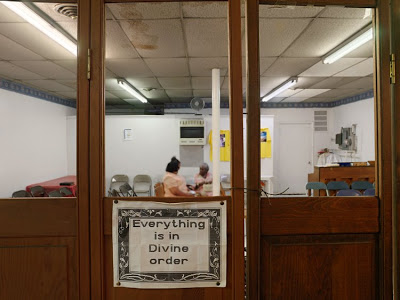
Entrance ~ Dave Jordano

I just received an email this morning from a dear friend who lives in DC...
"We were walking to work this morning, and a block from our house, Obama was speaking at a national prayer breakfast (at the Hilton hotel). It is crazy to start walking, not quite yet awake, and run into secret service and the most black suvs with tinted windows you have ever seen fit into a hotel parking lot. We asked a cameraman what was going on and he said "Obama is praying for us".
Click here to read about it in the New York Times.Articles of Faith, Dave Jordano

Speaking of Faith, I have just learned about the soon to be released photographic book by Chicago photographer Dave Jordano titled Articles of Faith. The work is FANTASTIC. Click here to get to his website.
Dave states “This documentary project investigates the concept of how a sense of belonging and place can influence the development of a small segment of a community and helps preserve long-standing traditions of cultural and religious belief.”

Pulpit, Chicago Traveler's Rest Spiritual Church, 2006 Dave Jordano

Darius Himes, a Santa Fe based writer and publisher wrote a review of the work which is posted on his blog...
“The vast diversity of religious expression that is found on our planet stems, ultimately, from the vast diversity of humanity itself. Jordano’s photographs of Christian faithful and the houses of worship on chicago’s south Side are a telescopic view of the richness of spiritual sentiment and devotion that has flourished in one tiny corner of this vast, diverse landscape. The insightful and educative essay by Carla Williams is of particular note, perfectly complementing the tender gaze of Jordano’s images. Out of the specificity that these photographs of such particular places conveys rises a sense of binding unity. Worship of the Divine, no matter where it is found, is touched by the same set of universal human impulses and yearnings. The tension between the particular and universal is wonderfully captured in this book.”
Pastor Mallett's Back Room 2005, Dave Jordano

Discoveries ~ Lynda Lowe

Evidence by Lynda Lowe

I am so happy to have discovered the work of Lynda Lowe, who is also one of the artists
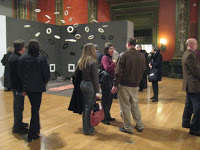
showing at The Poetic Dialogue at The Chicago Cultural Center. Her work is so evocative, mysterious, beautiful and epherimal. I can't wait to get back down to the exhibit to see her work again. Friday night was so busy and noisy (as most openings are) that I couldn't concentrate on the work.

There is much to be gleaned from the show and I think the panel discussion they have scheduled for Saturday, February 14th
in the Sidney Yates Gallery from 5:00-7:00pm should be very interesting.

The Poetic Dialogue Project opens tonight!

If you happen to live in or near Chicago you might consider attending the opening of The Poetic Dialogue tonight from 6-8pm at The Chicago Cultural Center Yates Gallery.
I have a piece in it called Ill Wind. A poem by Michael Ryan accompanies the piece along with a brief text on the process of making the work.
Mixed media (photograph, beeswax and masonite board), 30"x30"

Ill Wind
Two red birds
high on a wire
one said love
one said fire

Two black birds
deep in a tree
one said you
one said me

But wind came up
and tossed them away
no one hears
what they say


by Michael Ryan
"Ill Wind" first appeared in The New Yorker

The poem was etched on the waxed surface of the photograph then
melted. As the words blended with the image, something otherwise
inarticulate seemed to become embodied in the connection between this
particular poem and this particular photograph altered in this
particular way.

A review by Paul Klein in his Art Letter of the show:

"One of the most impressive exhibitions I’ve seen in a long time - the kind of substantive, meaty, thoughtful presentation I’ve been yearning for is titled Collaborative Vision: The Poetic Dialogue Project. (Thanks Fletcher for the reminder.) Curated by Chicago artist Beth Shadur, the exhibit pairs a poet and a visual artist. Obviously both have their artistic inclinations, but here there’s mutual respect and the challenge of responding to and incorporating the vision of the other.

This is the slowest exhibit I can remember; slow in the sense that here you want to spend a lot of time with each piece, to experience the different affinities of each contributor. Sometimes the most obvious collaborative act of putting words on art was what was done, but even so, reading the wall text, reveals the many different ways a consensus was arrived at. Other times words and images meld, like the time the text is laid on the painting in wax - and then melted. Or submerged under a reticular plastic so that alternatively you see text or an image. I found the show to be intensely rich, filled with thoroughly competent artists..."

An exhibition catalogue is available from Blurb by clicking here.
Other events planned for the exhibition.
Friday, January 30, 6-8pm: Opening reception, Yates Gallery
Saturday, January 31, 2pm: Poetry in Motion strolling poetry readings
Yates Gallery
Saturday, February 14, 2:30-4:15pm: Panel on collaborative process
with poets and artists, sponsored by the Ragdale Foundation, Claudia
Cassidy Theatre, 2nd Floor
Friday, February 27, 12:15pm: Curator's tour, Yates Gallery
Saturday, March 14, 2pm: Panel on collaborative process with poets
and artists, Claudia Cassidy Theatre, 2nd Floor
Thursday, March 19, 12:15pm: Curator's Tour
The exhibition closes April 5th and then will travel to other venues.

More on the Inauguration of Barack Obama and the Arts

I am still so amazed that we were able to elect a president who is not only supportive but also appreciative of the arts. During the We are One pre inaugural program/concert Ashley Judd and Forest Whitaker said these words:


"This is a day when artists from around our country celebrate history and our future. President Kennedy spoke of the role of the artist at Amherst College in 1963. “I see little of more importance to the future of country and civilization than the full recognition of the place of the artist. If artists can nourish the roots of our culture, society must set the artist free to follow his vision wherever it takes him”

Our great novelist, William Faulkner, when accepting the Nobel Prize, spoke of the artist too. “It is his privilege to help man endure by lifting his heart, by reminding him of the courage and honor and hope and pride and compassion and pity and sacrifice which have been the glory of his past. The poet’s voice need not merely be the record of man, it can be one of the props, the pillars to help him endure and prevail.”

It is still so amazing to me that Barack Obama is the President of the United States.

After the swearing in I heard Elizabeth Alexander recite her poem, "Praise Song for the Day." I had trouble focusing on it as I was worried about making my way out of the mall to catch a plane back to Chicago. I have since read it online and think it is amazing, especially the line, "What if the mightiest word is love? "

Here is the transcript of the inaugural poem provided by Graywolf Press in its entirely:

Each day we go about our business, walking past each other,
catching each other’s eyes or not, about to speak or speaking.

All about us is noise. All about us is noise and bramble, thorn
and din, each one of our ancestors on our tongues.

Someone is stitching up a hem, darning a hole in a uniform,
patching a tire, repairing the things in need of repair.

Someone is trying to make music somewhere, with a pair of wooden spoons on an oil drum, with cello, boom box, harmonica, voice.

A woman and her son wait for the bus. A farmer considers the
changing sky. A teacher says, Take out your pencils. Begin.

We encounter each other in words, words spiny or smooth,
whispered or declaimed, words to consider, reconsider.

We cross dirt roads and highways that mark the will of some one
and then others, who said I need to see what’s on the other side.

I know there’s something better down the road. We need to find
a place where we are safe. We walk into that which we cannot yet see.

Say it plain: that many have died for this day.
Sing the names of the dead who brought us here, who laid the train tracks, raised the bridges,

picked the cotton and the lettuce, built brick by brick the
glittering edifices they would then keep clean and work inside of.

Praise song for struggle, praise song for the day. Praise song for
every hand-lettered sign, the figuring-it-out at kitchen tables.

Some live by love thy neighbor as thyself, others by first do no
harm or take no more than you need. What if the mightiest word is love?

Love beyond marital, filial, national, love that casts a widening
pool of light, love with no need to pre-empt grievance.

In today’s sharp sparkle, this winter air, any thing can be made,
any sentence begun. On the brink, on the brim, on the cusp,

praise song for walking forward in that light.

The Inauguration of Barack Obama


…we were transported home last night by an amazing taxi driver. She asked to hear our story and said we were the eyes, ears and feet for those who did not make the trip to the US Presidential Inauguration.
So, before I talk to another friend or family member on the phone, here are some of the highlights of the trip.

We boarded our plane in Chicago bound for Washington, DC. It had the feel of a charted flight. The excitement on the plane was palpable. As the plane landed, people clapped.

Sunday afternoon we attended the pre Inauguration concert, We Are One, on the Washington Mall at the foot for the Abraham Lincoln Memorial. It was star studded. While we were waiting for the live concert to begin, they played THE AMERICAN PRAYER!
It precipitated a river of tears. It is my VERY FAVORITE song of the presidential campaign.


I am thrilled to have located a website where you can experience the WE ARE ONE concert for yourself.
Please, please, please, if you can, watch it by clicking here. It speaks to Obama’s vision of the past, present and future of this remarkable country thru song, film and the spoken word.


Forest Witaker’s comments about the arts was amazing. When I find the text online, I will post it.
We also had a chance to sing “This Land is Your Land” with Pete Seger. How cool is that?
My heart was soaring along with everyone else’s standing at the base of the Washington memorial.

Later, Jamie Fox asked “who out there is from Chi (Chicago) town?”
We raised our hand…we were the only ones within sight from Chicago. After feeling so out of place 4 years ago at Bush’s inauguration, I can’t tell you how nice it was to feel like we were the ambassadors of President Obama’s home town….very, very cool.


Monday night at 7:30, after spending much of the day with non inaugural events, we decided to see what the pulse of the city was. It was like New Years Eve magnified by 10 fold but even better because everyone was so happy and connecting with each other about their joy and excitement over the incoming administration.
We left our hotel room and passed the Hiton where many events were held. Multiple glass tinted black cars were pulling out of the driveway. We soon learned that the bipartisipan dinner in honor of Senator John McCain was just ending. We saw David Axelrod, senior advisor to President Obama, intently checking his cell phone messages. I was soooooo excited. The previous week I had coffee with a woman who I met thru phone banking during the campaign who knew him years ago in college at the University of Chicago. I went up to David and introduced myself and told him about this person. He couldn’t have been nicer and asked what she was doing. What a thrill it was to have met him.

Before leaving home I heard a wonderful piece on Chicago Public Radio about the Big Shoulders Ball organized by The Hideout at the Black Cat Lounge in DC that was featuring all Chicago musicians. It captured my imagination as they talked about the all night bus ride into the capital. Well, we walked to the Black Cat (passing Ben's Chilli bowl that had a long line of revelers)

only to find there were no tickets to be had. We waited outside for a bit and eventually struck up a conversation with the driver of the Chicago bus who was outside for a cigarette break. He filled us in on the details. We took a few photos and decided to proceed down to the Mall.


All thru the night there were more and more street closings (to motor vehicles). Street workers were constructing blockades and checkpoints as we made our way to dinner.


This is where I stood to protest Bush's inauguration in 2004.

We passed the Warner Theater at 11:30 where the Jay-Z (a hip hop super star) concert was letting out. At $500.00 a ticket, it was a well-heeled crowd donning interesting Obama gear.

We greeted the new day with a late dinner at the famous Old Ebbitt Grill, located 1/2 block from the White House. The restaurant was scheduled to be open until 3am. After a very satisfying dinner we were escorted out via the rear door as Pennsylvania Ave was succumbing to the encroaching lock down. As we made our way back to the hotel, the city had an eerie feel of anticipation and magical transformation.

Needless to say, I was much too excited to sleep.


We left the hotel at day break. There was already a steady stream of people walking down Connecticut Avenue toward the mall.
A sense of commaradie filled the streets as we approached the
Washington memorial. As the sun was rising, the birds were circling the Washington monument and the Bruce Springsteen song, The Arising, was blasting out of the large TV screens, filling the air.
This was one of those magical moments that will be seared in my memory forever…
"Come on up for the rising_Come on up, lay your hands in mine"


We settled into our viewing spot perched on top of the hill under the Washington monument with a clear view from the mall to the US Capitol building. This was the dawning of a new day in the history of the world.


4 hours later I watched the sunset aboard a plane headed back to Chicago and for the first time in my life I saw the green flash.


What a blessed time this is.

Reflecting on the Bush Inauguration in 2005

As I prepare to take leave for Washington DC to join in the nationwide celebrations of Barack Obama's election to the US Presidency, I can't help but look back to 4 years ago when I attended George W. Bush's inauguration as a protester.

It was a very emotional time. We were in a war few Americans wanted to be in. The country was severely divided. As Bush said, "if you are not with us, you are against us." Never in my lifetime have I felt so marginalized by my government.

There were many, many protesters participating in demonstrations through out the capital. I marched in some of them. What amazed me was that there was no mention of any of them in the media. Talk about feeling invisible!
Here are a few images from the 2005 presidential inauguration...


I heard Bush give his final press conference earlier this week. One (of many) comments given made my jaw drop....
Question:
When you look back over the long arc of your presidency, do you think, in retrospect, that you have made any mistakes? And if so, what is the single biggest mistake that you may have made?

THE PRESIDENT:
I've thought long and hard about Katrina -- you know, could I have done something differently, like land Air Force One either in New Orleans or Baton Rouge. The problem with that and -- is that law enforcement would have been pulled away from the mission. And then your questions, I suspect, would have been, how could you possibly have flown Air Force One into Baton Rouge, and police officers that were needed to expedite traffic out of New Orleans were taken off the task to look after you?

WOW

New Work Inspired from San Miguel de Allende


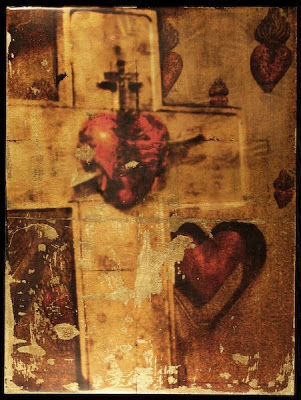
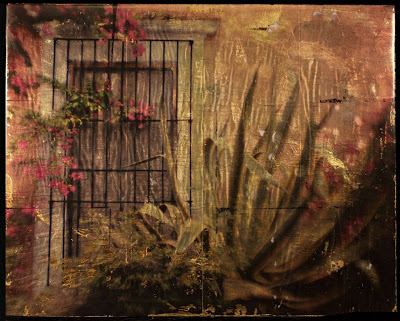
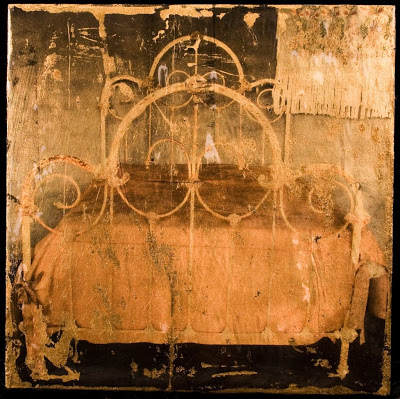
After much a do, I am happy to say that my new work from Mexico will be ready for viewing next week at Frontera Grill / Topolobampo in Chicago. After much thought I decided to try something new. These images are laid over gold leaf and covered with resin. It was fun experimenting with the new materials. My studio is a total disaster now. Time to start creating some order.....


Which makes me ponder the "branding" issue in art making. They say that it is good for an artist to have a certain style or identifiable mark that allows the collector to say "that is a ________(name of the artist)." Well, they are not going to pin me down! Life is too short. Part of what makes art making so much fun is experimenting with different materials.

Stay tuned for my ramblings on the upcoming United States Presidential Inauguration. I will be in full attendance with photos to share!

The Gift by Lewis Hyde

I received The Gift (a book) over the holidays. Ever since returning from exhibiting at The Pool Art Fair at Art Basil, I have been trying to find a deeper understanding of how the creative process interfaces with the art market...so far, I only have more questions.

This is an interesting and (for me) a challenging read.

Here is part of an interview from the LA Times, January 13, 2008

THE WRITER'S ART

Hyde’s 1983 book “The Gift,” subtitled “Creativity and the Artist in the Modern World,” argues that inspiration comes to its creator the same way a gift does. Because of this, both the artist and the resulting work itself become uneasy in a market economy. This gift is most comfortable, instead, when it is kept moving – offered or traded – instead of being hoarded or commodified.

Over the years, “The Gift” has developed a cult following among writers and artists who rarely lend their names to anything as potentially sentimental as a book on “creativity” – David Foster Wallace, Zadie Smith and Geoff Dyer among them. To Jonathan Lethem, it’s “a life-changer”; video artist Bill Viola calls it “the best book I have read on what it means to to be an artist in today’s economic world.”

But when “The Gift” was released in Britain for the first time a year ago, it also drew some scorching reviews. “I have to say,” argued Tibor Fischer in London’s Sunday Telegraph, “I’m a little suspicious of someone who draws his proofs from fairy tales and the behaviour of tribes in the South Pacific, as Hyde does, since they can be used to argue just about anything.”

Now there’s a 25th anniversary reprint out, with a new afterword. We spoke to Hyde – a poet and Thoreau and Ginsberg scholar who lives in Cambridge, Mass., and teaches at Harvard and Kenyon College – about his thesis, his critics and how his critique of the market economy speaks to us in an age of capitalism triumphant.

I can’t think of a succinct way to describe “The Gift.” Can you?

The main assumption of the book is that certain spheres of life, which we care about, are not well organized by the marketplace. That includes artistic practice, which is what the book is mostly about, but also pure science, spiritual life, healing and teaching.

This book is about the alternative economy of artistic practice. For most artists, the actual working life of art does not fit well into a market economy, and this book explains why and builds out on the alternative, which is to imagine the commerce of art to be well described by gift exchange.

What made you choose folk tales and fables as the bases for your argument, as opposed to, say, the lives of artists?

The book has two halves, and the first builds a theory of gift exchange and the second applies it to some cases in art. To do the theory, I chose folk tales and mythology because they are closer in their language and their imaginative universe to the world of art. Most of the work on gift exchange comes out of social science, either out of anthropology or some branches of economics. It’s interesting, but it’s not as figurative in its language. So I turn to them as a way of widening what’s already known in the social sciences.

Is there a sense that in using stories from all over the world you’re getting at something universal, or essential, or timeless, or something like that?

This is, of course, a cultural debate we’ve had for some time now, whether there are essential and timeless categories like this. In a sense, yes, using folk tales and myths was an attempt to get the argument out of the particular and into a more general language.

You talk about a tension, a disconnect, between the artist’s inspiration and his ability to take his work into the marketplace. But haven’t many artists, especially since Warhol and going back at least to Shakespeare, been quite adept at the marketplace?

Yes, of course. And my argument is not that artists can’t do that – they can, and I think it’s wonderful when they succeed. But I think there’s this double economy nonetheless.

Just to take Warhol as a quick example: He was quite cunning about commercializing fine art. But the fact is the largest last piece of his was a series of over 100 silk-screens, which was funded by the Dia Art Foundation. To do a large-scale work of that kind, Warhol still needed a patron. So you always find this mix, even in someone as commercially canny as Warhol.

It does seem that artists and novelists have lost some of their distance from the marketplace, some of their disdain for it. We know that Tom Wolfe, for instance, just left his longtime publisher for one that’s given him a bigger advance. It seems much more common these days to talk about art and literature with a dollar sign attached. Does this seem different from when you were writing the book in the ’70s?

Probably not. I think there’s always been a star system that has that kind of element. But the thing to realize when you’re talking about a writer like Tom Wolfe is that this is like talking about the very best baseball or basketball players in the world, and there are 100,000 people who are not at that level, who I’m thinking about.

Most of the fiction writers I know struggle to make a living from their writing and have to take second jobs. And for those people it’s important to remember that it’s not a failure on their part: It’s a structural problem that comes with the practice of art.

You talk about a resurgent “market triumphalism.” Have our attitudes toward the marketplace changed since the book came out?

That I do think has changed. Beginning in the early 1990s, we got an era of market triumphalism in this country. Those who sincerely believed that the market is the best way to deliver all things are still enjoying their moment.

It means that these other realms that are not as well delivered in that way are suffering. This includes questions of how we fund higher education, secondary education, healthcare, how we fund the humanities, the arts and pure science. And since the early ’90s, the move has been to try to do all of this through private enterprise.

On that note, one of the critics of your book accused you of having “a hippy disdain for ‘the market economy.’ ” Is that fair?

I think it was fair when I began, but I don’t think it’s fair now. I began with a real attachment to the gift-exchange side of this equation, and in a sense the book overemphasizes that, intentionally so because I felt that it was not well described or thought about. But as I said in my afterword, I ended up realizing the real problem was to have a consciousness about the two realms and to think about ways they could communicate usefully with each other.

So I have nothing against the marketplace, when it’s applied to the things it works well doing. And my books are for sale.

Your book has a real following among artists and writers. But most people turn to a book on creativity for solutions, practical advice on how you can channel “the artist within.” Your book is more philosophical.

I suppose there are two kinds of practical guides: One is a guide that explains how you can change something, and do it differently. Another kind shows what you cannot change and describes the situation clearly – which I think is also a help, to understand that the nature of artistic practice means the artist is often disconnected from the marketplace. It relieves people of the false assumption that if they were doing something different, they would be able to make more money from their art.

Maybe you’re simply reminding people that artistic work has its own dignity and value: It doesn’t need to be commodified by the marketplace to be worthwhile.


Absolutely. It has a value of its own, and sticking to that value is going to bring a satisfaction that you can’t get elsewhere.

I have a line in there where I say that artists need to be able to retreat to those bohemias halfway between the library and the slums, or something. It’s nice if a culture can provide the spaces where somebody can do these kinds of work that matter, instead of putting pressure on them to live at an unattainable standard of living.

When the National Endowment for the Arts was set up, one of the lines in the legislation was that a great nation cannot call into being an artist or a humanist. But a nation can provide the support without which no artist can survive. That’s an ongoing question.

scott.timberg@latimes.com

from Bill Viola..my favorite video artist

“I think that any time you are making something that touches the inner self of the human being, anything that emerges out of ourselves from a genuine, unguarded place is ultimately a sacred act, no matter whether you follow a religion or not. All of the things that surround us came out of the inspiration of transforming the material world into our inner vision..."

Random Acts of Kindness


so i drove into Chicago for a meeting yesterday.
i was running late and found a metered parking spot within a block of my destination on a very busy street (ontario street just east of michigan avenue).

only problem...no change.

there was a city employee who was emptying the change out of the meters.
i asked for change. he said he couldn't do that. i asked someone else on the street for change.
they didn't have it.
next thing i know, he reset the meter for 2 hours and said happy holidays!

random acts of kindness just blow me out of the water.

Tis The Season


Walking down the Magnificent Mile last Sunday I had a chance encounter with some hearty souls
(enduring the cold northerly blast of wind) who were administering FREE HUGS to whomever desired them.
Can you imagine?
It was so much fun to watch people's reactions. I mean really...who wouldn't want a hug in this economic and political climate?

Gregory Scott


Age Of Spontaneity by Gregory Scott

If you are not familiar with the work of Gregory Scott, you might want to be. I saw his new work at the Catherine Edelman Gallery in Miami and he has pushed photography to a new level.
Not only has he inserted his painted self into the frame, he has also added video seamlessly. You need to go to his website to play the video, well worth the visit. It is so amazing to see the creative mind at work.